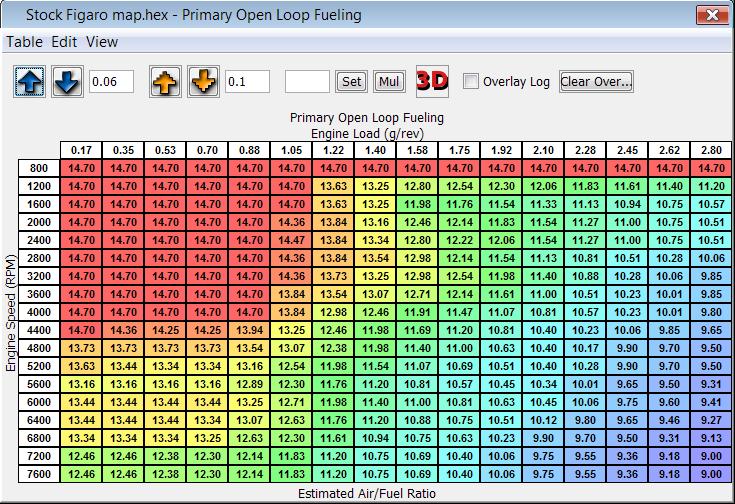
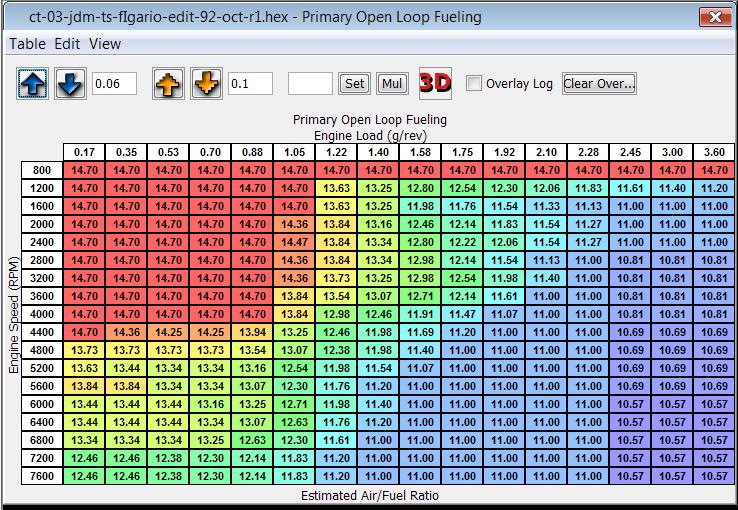
OPEN LOOP
There are times when we want our car to not run the stoich
AFR. This would be when we are trying to make a lot of
POWER by compressing the air/fuel mixture as much as possible before the spark plug ignites it. So what
AFR should we run?
A 12:1 AFR is good for POWER, but dangerous to the engine. It would be good for an aggressive tune on a car that you won't mind if the engine goes. The more reliable AFRs of 10.5:1 to 11:1 for a TMIC and 11:1 to 11.5:1 for an FMIC are usually used on a daily driver. The tricky part is figuring out how much fuel you need since there is no feedback. This is where your Mass Air Flow sensor comes in. The MAF is just a heated wire. The ECU tries to keep that wire heated to a certain temperature, but as air flows over the wire, it cools it. So the more air that is sucked into the engine, the more voltage will be required to keep the wire at the set temperature. So that voltage can be mapped to a given amount of grams of air per second going into the engine. So, for example, if the MAF sees 2.6 volts, then the ECU knows the engine is eating 126 grams of air per second. Knowing this, the ECU looks at what
AFR you want to run; takes into account any necessary compensation; and determines an injector pulse width to give you the
AFR you’re looking for. The pulse width is the amount of time the injector is open and (along with the fuel pressure) determines how much fuel gets squirted into the engine. As you can see, the ECU never knows what the real
AFR is while in open loop. It’s up to the tuner to determine what
AFR the car should be running and setup the ECU parameters to make the actual and requested AFRs match up.


 LinkBack URL
 About LinkBacks





 Сообщение от Figaro